

High-Protein Peanut Butter Praline Ice Cream (No Churn)
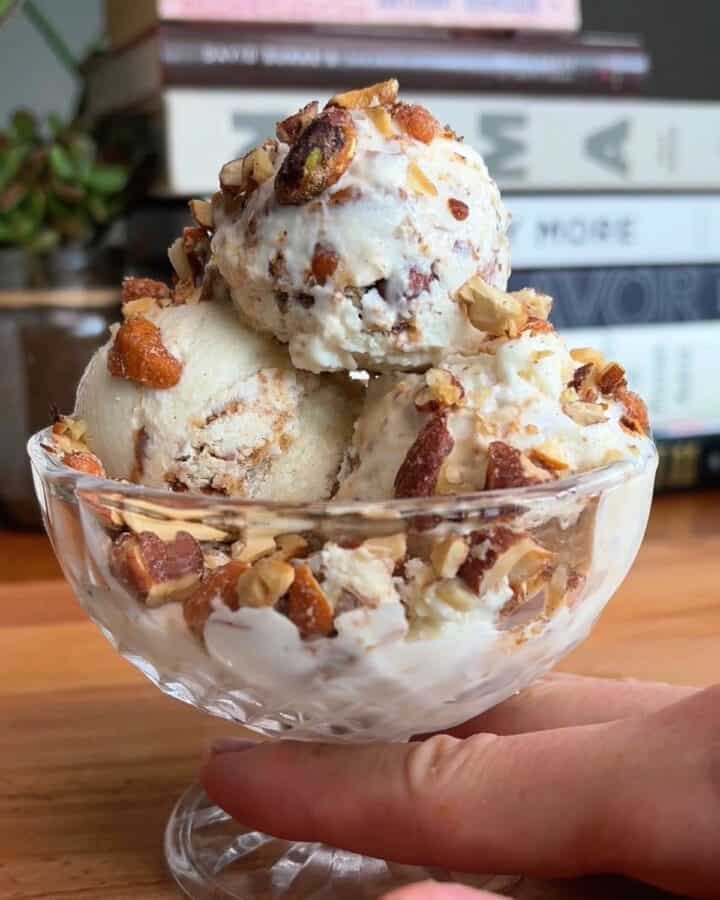
This cottage cheese ice cream has a peanut butter swirl, praline-style crunch, and 13g of protein per serving. No ice cream maker needed, no cream, no compromise on flavor. Sweet, salty, creamy, and completely addictive straight from the freezer!
Jump to:
You know I've been on a bit of a high protein ice cream roll.
First came chocolate banana. Then blueberry swirl. Then pistachio. Add in a two-ingredient caramel sauce and suddenly I realized I was very far from done.
This peanut butter praline cottage cheese ice cream might be my most dangerous one yet.
It tops the list of my 15 best high protein desserts list because there's just something about the combination of rich peanut butter and crunchy praline that hits every craving at once. Sweet, salty, creamy, crunchy. It tastes like a guilty pleasure, but somehow isn't one.
The base is blended cottage cheese, which is same approach I use across the whole ice cream series. Cottage cheese is incredible because when you blend it long enough and it goes completely smooth, it has a creaminess that genuinely surprises people the first time they try it.

This ice cream is so wildly easy to make, which is both a gift and a warning!
Why This Cottage Cheese Ice Cream Works
Blended Cottage Cheese Creates a Genuinely Creamy Base
The most common objection to cottage cheese in a dessert is the texture (grainy, lumpy, etc.). Blending eliminates all of that. The curds break down completely and the fat distributes evenly through the liquid, creating a smooth, thick base that freezes with a creaminess that milk or cream-based no-churn ice creams often can't match. The key is blending longer than you think you need to. Thirty seconds usually isn't enough. Ninety seconds to two minutes until the mixture is completely smooth and slightly aerated is where you want to be.
Peanut Butter Swirled In After Blending, Not Blended Through
If you blend the peanut butter into the cottage cheese base, it distributes evenly and adds richness but disappears as a distinct element. Swirling it in after (folding gently to create ribbons rather than stirring to combine) gives you pockets of concentrated peanut butter throughout the ice cream. Some bites are heavy with it. Some are lighter. That variation is what makes each spoonful interesting rather than uniform.
Roasted Nuts Add the Praline Element Without Caramelizing Sugar
Traditional praline is made by cooking sugar with nuts until the sugar caramelizes and hardens around them. This version uses roasted nuts folded into the base instead. It's simpler (there's no hot sugar to manage) but has the same principle of crunchy nut pieces distributed through a rich, sweet base. Roasted nuts are the key. Raw nuts don't have the depth of flavor or the satisfying crunch that makes the praline element work. Toast them yourself if you can, five minutes in a dry pan over medium heat makes a noticeable difference.
Sugar Keeps the Freeze Softer
This is worth knowing for any frozen dessert made without cream. Maple syrup or honey don't freeze solid the way water does. The sugar molecules interfere with ice crystal formation, which keeps the texture of the finished ice cream softer and more scoopable even after a full overnight freeze. This is also why adding more sweetener is the fix if your ice cream comes out too icy. Sugar is doing structural work in a frozen dessert, not just adding sweetness.
"This might be my cottage cheese ice cream FAVE. I have tried a few of Chef Josh's ice creams - and they are all good, but this one might be the best. It tastes so sophisticated and riche with the praline twist. Highly recommend."
Kate (email subscriber)
Recipe

Peanut Butter Praline Cottage Cheese Ice Cream
Watch:
Ingredients
Equipment
Method
- Blend the Base: Add cottage cheese, maple syrup or honey, and vanilla to a blender or food processor. Blend for 90 seconds to 2 minutes until completely smooth, creamy, and slightly aerated. Don't stop too early.

- Transfer: Pour the blended base into a freezer-safe container and spread evenly.

- Add the Mix-ins: Spoon peanut butter over the surface in dollops. Sprinkle the chopped roasted nuts over the top. Fold gently two or three times to create ribbons and pockets of peanut butter throughout. Don't stir to combine.

- Freeze: Cover with plastic wrap pressed directly against the surface, then the lid. Freeze for 4 to 6 hours until firm.

- Serve: If frozen solid, let sit at room temperature for 30 to 45 minutes before scooping.
Notes
Nutrition
Tried this recipe?
Let me know how it was!Common questions about this High-Protein Peanut Butter Praline Cottage Cheese Ice Cream
Once blended smooth, the cottage cheese flavor essentially disappears. What you get is a creamy, lightly sweet base that tastes like a richer, denser frozen yogurt. The peanut butter and praline flavors are the dominant notes here, most people have no idea cottage cheese is involved until you tell them. The texture is the most surprising thing: genuinely creamy and scoopable, not icy or grainy.
Two likely causes. The cottage cheese wasn't blended long enough (under-blended base has more free water that freezes into larger ice crystals). Or, the ice cream has been frozen for more than 24 hours, during which the water molecules naturally recrystallize into larger formations. The fix for both: blend longer and add more sweetener, since sugar molecules actively interfere with ice crystal formation and keep the texture softer. Pull from the freezer 30 to 45 minutes before serving.
No. This is a no-churn recipe! Blend the base, fold in the mix-ins, freeze. No special equipment required beyond a blender and a freezer-safe container. The cottage cheese base freezes with enough creaminess that the churning step traditional ice cream needs to prevent iciness isn't necessary.
This recipe has approximately 13g of protein per serving, primarily from the cottage cheese and peanut butter. The exact amount varies slightly depending on the cottage cheese brand and whether you use peanut butter or almond butter. Full-fat cottage cheese brands like Good Culture tend to run slightly higher in protein per cup than store-brand versions.
Yes. Almond butter gives you a milder, slightly less sweet result. Cashew butter is creamier and more neutral. Sun butter works if you need a nut-free version. The technique is identical regardless of which butter you use. The key is swirling it in after blending rather than blending it through, so you get pockets of flavor rather than a uniform mix.
Up to one week in an airtight container. Press plastic wrap directly onto the surface before sealing to prevent freezer burn and ice crystal formation on the top layer. The texture is best in the first two to three days. After that it becomes progressively icier as the water molecules recrystallize.
More recipes you'll love
A few favorites I think you'll really enjoy next.
- High-Protein Chocolate Banana Ice Cream6 Hours 10 Minutes
- High-Protein Strawberry Ice Cream4 Hours 10 Minutes
- High Protein, 3-Ingredient Pistachio Ice Cream6 Hours 5 Minutes
- Easy Watermelon Sorbet (No Ice Cream Maker Needed)2 Hours 5 Minutes


Is there a non-dairy alternative to the cottage cheese?
Hi! Yes, dairy-free cottage cheese alternatives (there are a few brands out there now, usually made from almond or cashew bases) should work here as a straight swap. A couple of things worth knowing: dairy-free versions tend to run lower in protein than real cottage cheese, so the 13g protein per serving will drop somewhat depending on the brand you use. They can also have a slightly different water/fat balance, so blend it just as long (90 seconds to 2 minutes) to make sure it's fully smooth, and keep an eye on iciness after freezing since that balance affects how well the base holds up. If it does turn icier than you'd like, bumping up the maple syrup or honey slightly helps offset that. Let me know how it turns out if you try it!
Hello, can I use ricotta cheese instead of cottage cheese?
Sure can! Same ratio. This recipe is very forgiving!
I’m going to make this with almond butter & I’m thinking of adding chopped candied almonds.
YUM. That sounds DELISH!
Could Splenda be used to reduce sugar content for a type 2 diabetic?
Hi Sharron! Splenda works, but there's a catch: the maple syrup/honey in this recipe isn't just for sweetness — it also keeps the ice cream from getting icy. Sugar interferes with ice crystal formation, which is why I often tell people to add more sweetener if theirs turns icy.
Splenda doesn't have that same anti-freeze effect, so a full swap will likely make the ice cream icier, which isn't always ideal.
Better options:
Try allulose or monk fruit syrup instead of Splenda — these actually mimic sugar's texture benefits in frozen desserts.
Or, do a half swap: replace half the maple syrup/honey with Splenda, keep the other half real, and add a splash of milk back in since you're losing liquid volume.
Either way, eat it within the first day or two for best texture, since a Splenda swap will make it turn icy faster than the original recipe!
Hi Josh,
Would adding up to 2 tablespoons of vodka deter some ice crystal formation?
That's what I normally use when making homemade ice cream. I've never made a cottage cheese-based ice cream before, so I need your expertise. Thanks!
Ooooo. Please it a try and please let me know! I would expect it to work well, as you're right, in "typical" ice cream the vodka deters ice crystals. Definitely worth an experiment. 🙂
But how many scoops is considered a serving, 1,2,3?
Hi Nick, that totally depends on your scoop size, etc. I usually count on this recipe for about 6 dessert servings (each of about 2-3 household ice cream scoops).
Is the whole recipe ONE serving? Or how many servings does the recipe make??
The recipe makes 6+ servings! 🙂
Can this be made in a ninja creami?
Yes, and I would loooooove to hear about how it goes! I want a Ninja Creami, but am trying to hold back from making the purchase (I have too many appliances already). Please try it and let me know what you think!
Yes, I just did this last night, eating it now…YUM. I blended everything together, froze 24 hours, processed on “soft serve”, “creami fit” then when it was done added 1T mini chocolate chips and finely diced peanuts and ran the “mix in” cycle
Um, YUM! Thanks for sharing Rebekah!
I made this ice cream and it is delicious but I'm having a problem with it getting icy. I take it out of the freeze about 30-45 minutes before serving What am I doing wrong?
If you leave it overnight and pull it the day after, it might get a little frosty. :/ That's just the nature of this recipe. If the frostiness is a bother, you can add more sugar (sugar doesn't freeze, so it keeps the iciness to a minimum).